Overview
Featureflow is a feature management platform that helps you safely release, control, and test features in your applications. Use feature flags to separate deployment from release, run A/B tests, and progressively roll out new functionality.
Get started
Pick the route that suits you:
- Quick Start - AI coding agent — install the Featureflow skills and ask Claude Code, Cursor or Copilot to add Featureflow for you. Usually a few minutes.
- Quick Start - Server — add a server SDK by hand (Java, Node.js, .NET, Ruby, Go).
- Quick Start - Frontend — add the JavaScript client SDK by hand.
Key Concepts
Organisation
Your organisation is the top-level account that owns all projects, environments, and team members.
Project
A project represents a single application or product. You might have a backend API, a web app, and a mobile app all managed under one project.
Environment
Each project has multiple environments (e.g., Development, Staging, Production). Each environment has its own SDK keys and independent feature configurations, allowing you to test features before releasing to production.
Feature
A feature is a flag you control through Featureflow. Each feature has a unique key used in your code and can be configured differently per environment.
Feature Control
A feature control is the per-environment configuration for a feature — the rules and variants that determine what users see.
Variant
When a feature is evaluated, it returns a variant. The simplest features have two variants (on and off), but you can define any number of variants for more complex scenarios like A/B testing (control, variant-a, variant-b) or versioning (v1, v2).
User
When evaluating a feature, you pass a user object with a unique ID and attributes (e.g., tier, country, signup_date). These attributes power targeting rules to control which users see which variants.
Architecture
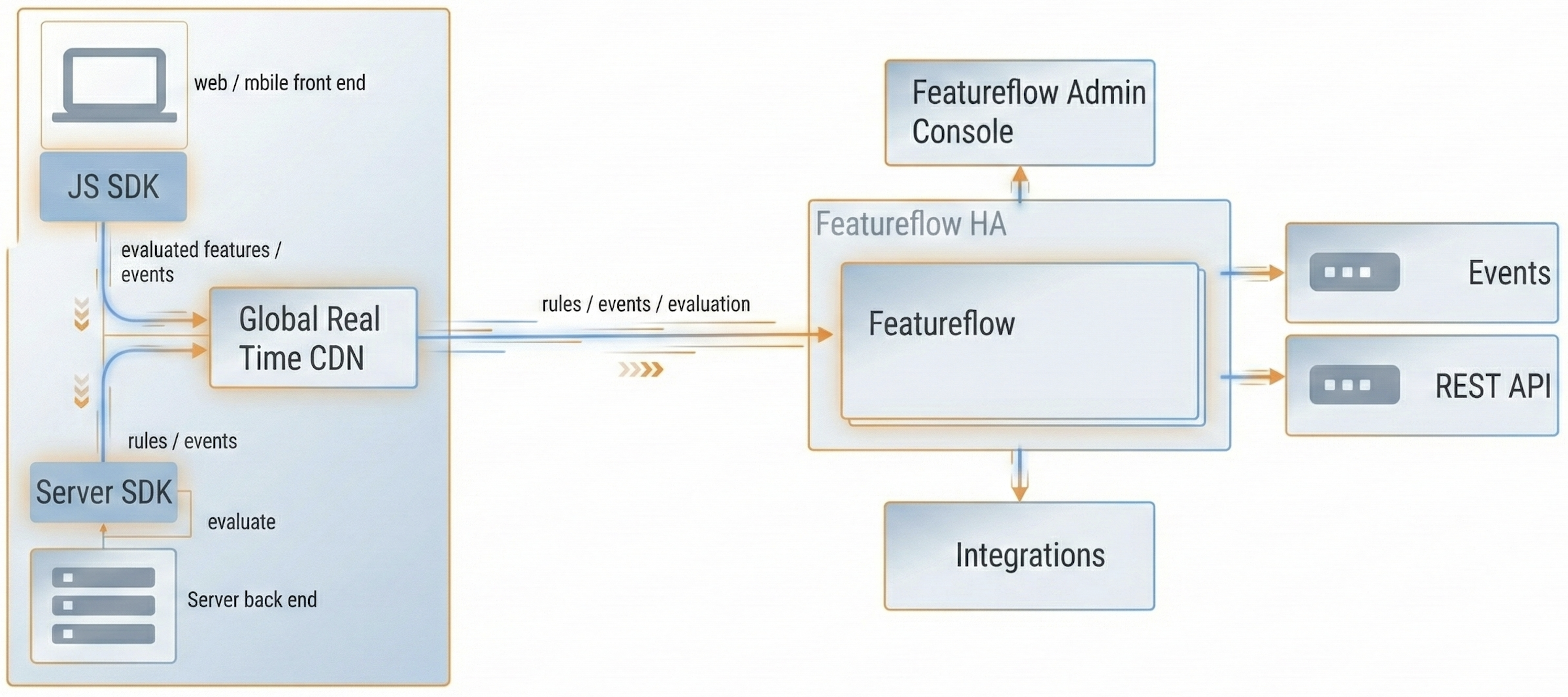
Featureflow delivers feature configurations through a globally distributed, highly available CDN.
Server SDKs
Server SDKs download and cache feature rules locally. Evaluations happen instantly in-memory — often faster than a database lookup. Rule changes are pushed to SDKs in real-time.
Client SDKs
Client SDKs (JavaScript, React, mobile) call Featureflow's CDN to evaluate features. This keeps your client bundles small and ensures users always get the latest configuration.
Events
Both server and client SDKs send usage events to Featureflow, powering the analytics dashboard to show feature status and usage across your application.